Project · AI safety
EHR Copilot: what it solved and how

AI-powered clinical note generation for psychiatric sessions with built-in verification and Indian data compliance.
The full explanation
What EHR Copilot is and what problem it solves
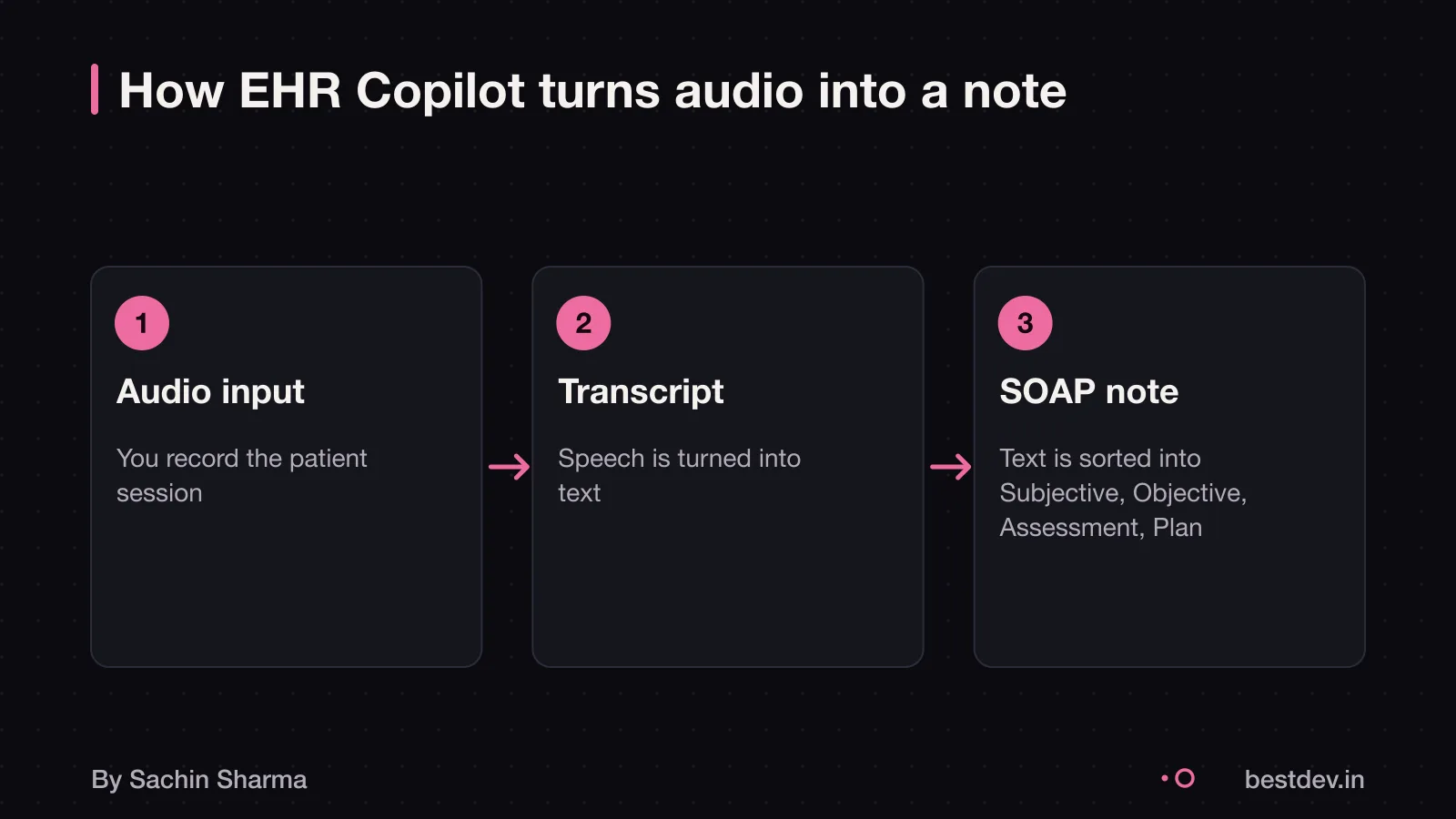
EHR Copilot turns spoken words from a psychiatric session into structured clinical notes using AI. It creates SOAP notes, Subjective, Objective, Assessment, Plan, that fit into an electronic health record (EHR) system. The tool needs review and editing by the doctor before use. It does not replace clinical judgment. This is a general principle and not stated in the evidence. It works like a digital scribe and reduces paperwork. It does this at lower cost and can scale more easily, as shown in studies of similar software. It can transfer clinical summaries to an electronic health record (EHR), as shown in tools like DAX Copilot. An API is a secure way for software to share data. Whether EHR Copilot uses one is not confirmed. You can send the full note or just parts into your EHR after editing.
Do you actually need a tool like this?
There is no evidence specifying a threshold like five sessions per day. There is no evidence confirming whether it works better for psychiatrists, therapists or clinics with standardised workflows and digital records. It is not known if the setup cost and review time pay off for solo practitioners with low patient volume. As an estimate, assuming a clinic does 20 sessions a day, note-writing might be cut from two hours to 30 minutes with AI drafting. It is not known whether typing or voice-to-text is quicker or more accurate for practitioners seeing three patients daily. There is no evidence to confirm whether testing the tool with your own session types before full adoption helps.
How much it costs to build and what changes the price
A custom EHR development costs $50,000 to $500,000+ depending on the approach. A platform-based build uses Medplum or Healthie. It costs $50,000 to $150,000. The platform handles FHIR infrastructure. You build only the clinical layer. A full custom build from scratch includes ONC certification. It costs $300,000 to $500,000+.
Each EHR integration adds $10,000 to $30,000 to the cost. ONC certification adds $200,000 to $500,000+. It takes 12 to 18 months if done without a third party. SOC 2 Type II compliance adds $50,000 to $150,000 for audit and system fixes.
The final cost depends on whether you use a platform. It also depends on how many systems you integrate with. It also depends on which certifications you need. Building on an existing healthcare platform cuts cost and time. Full self-certification is expensive and slow. For local cost context, see How to estimate app cost in India.
When benefits appear after launch
You see workflow efficiency gains in 6 to 9 months, revenue cycle improvements in 9 to 18 months. Infrastructure cost savings ROI within 12 months of launch. These timelines depend on staff training, system uptime, and how fast your team adopts the tool. For example, if doctors use the AI note-taker daily, documentation time drops sooner, speeding up billing cycles. Infrastructure cost savings can occur after cloud migration, as seen in a client case with 30-40% reduced spend, according to Mindbowser. The data is from a 2026 guide by Mindbowser, based on U.S. healthcare clients. Timelines for Indian clinics are not known.
How it is built: steps and your role
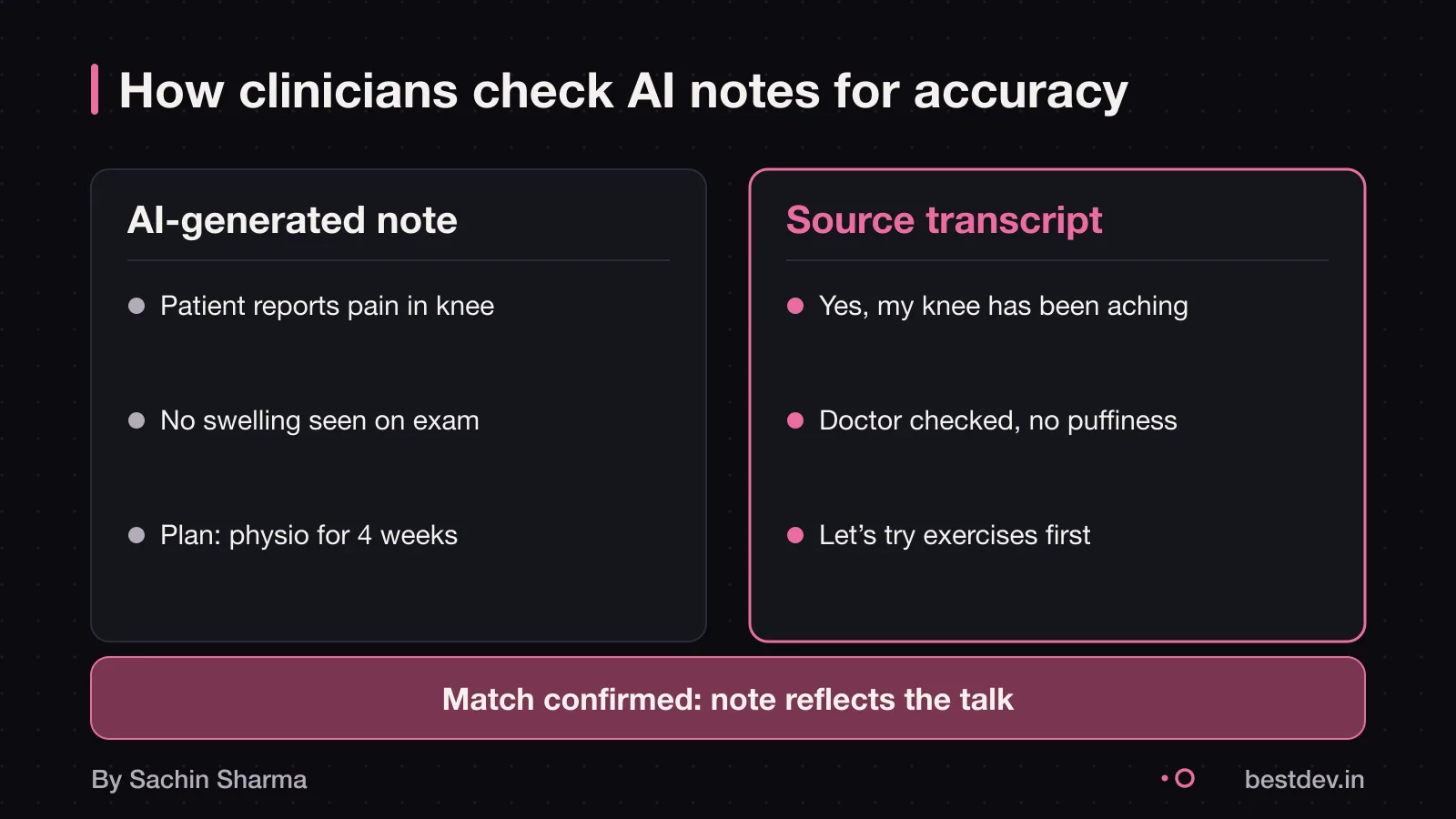
You review, finalise and sign each note in the EHR to ensure it is accurate and complete.
Transcripts can help train AI models. In one study, 97 de-identified audio recordings of clinical encounters were used, and 194 notes were created for paired review.
You may help design the note format, label key phrases in sample sessions, and test early drafts. In projects like Legease, real examples can guide the AI to learn your style and terms.
Web or mobile app?
You can use EHR Copilot on mobile and edit or transfer notes via desktop integration, as supported by integration with Dragon Medical One. On mobile, you record sessions using an iOS device (iOS 16+, recommended iPhone 8 or newer) with the DAX Copilot app. Mobile lets you capture clinician-patient conversations during visits, so you can stay focused on the patient while documentation happens automatically.
What can go wrong and how to reduce risk
Yes, the AI can leak personal data. As of 2026, 35% of AI systems exposed personally identifiable information (PII) according to one report. This can happen when prompts or memory stores are not sanitised before output.
It can also be hacked or tricked. In testing, 82% showed prompt injection exposure, 61% exposed internal instructions, and 49% allowed jailbreak bypass. These flaws could let attackers extract data or force wrong outputs.
The tool must never diagnose or recommend treatment, as AI errors in clinical advice increase legal and patient risks. Always keep a human in the loop for review.
To reduce risk, run security testing before launch, especially if you are deploying a clinical AI assistant, healthcare chatbot, or similar AI system. Use tools that test AI-specific vulnerabilities, not just standard web security.
For Indian apps, consider data privacy rules such as the DPDP Act. Consult a legal expert to know your obligations for user consent and data protection.
How to verify AI-generated notes
To check quality, use the modified PDQI-9 framework, which includes 11 criteria rated on a Likert scale. Two blinded specialty reviewers evaluated each note independently in the study.
In one study, 47% of reviewers preferred ambient notes compared to 39% for gold-standard notes. Reviewers showed high agreement (RWG > 0.7), meaning their judgements were consistent.
You can apply a similar review method to legal AI outputs. See how Legease, a Flutter AI legal-document platform, works.
Laws, consent and data rules in India
Yes, the Digital Personal Data Protection (DPDP) Act applies if you collect patient data in digital form, or digitise it later, within India. It also applies if you process such data abroad but offer services to patients in India. You must get consent before processing personal data, especially for health records, which are sensitive.
Patient consent is required before processing their data, unless an exception applies under Schedule 7 of the Act. For children, the parent or guardian is the Data Principal and must give consent on their behalf. You, as the app builder or clinic, are the Data Fiduciary and must protect the data.
To verify a parent’s identity, use trusted methods such as Aadhaar-based authentication or a digital locker service, where available. Do not accept claims at face value. This step is mandatory before processing any child’s health data. You must retain certain financial data, related transaction data and other logs of authorisation for at least one year from the date of authorisation. For purposes listed in the Seventh Schedule.
For full compliance steps, see the DPDP Act consent flows for Indian apps.

After launch: ownership and maintenance
The original developer should hand over source files and build assets if agreed in the contract. App transfers maintain the Bundle ID, and iCloud containers and 'Sign in with Apple' Service ID transfer if configured. The transferor must share the code directly with the recipient.
Annual maintenance costs 15 to 25% of the initial build cost. This covers updates, bug fixes, server costs and compatibility with new OS versions. For example, if your build cost $200,000, expect to pay $30,000 to $50,000 every year. These costs are ongoing and should be budgeted from launch.
You can check what is included after launch on our service page What is included after launch. See also: Can I get the source code of my app?
When this is not the right tool
When this is not the right tool
-
- Test carefully before adopting any AI note-taking tool. I have no evidence on whether such tools suit small Indian clinics.
- Always review every AI-generated note and confirm clinical decisions yourself. Whether there is published guidance on liability for AI-generated misdiagnosis in India is not known.
- An AI tool does not replace clinical judgment. It adds steps that must be managed. Regular audits, staff training and software updates are needed.
Questions people ask
What does EHR Copilot mean for a business owner?
EHR Copilot turns psychiatric session transcripts into structured SOAP notes using AI. This can reduce documentation effort as some software works like a medical scribe.
What do I need to decide first?
You must decide patient consent, data use purpose, and how data is stored before building the tool. These choices are required under India's DPDP Act, even if the tech is outsourced.
What can go wrong?
The AI may leak personal data or be tricked into revealing hidden instructions. As of 2026, 35% of clinical AI tools exposed PII, 61% exposed internal instructions, and 49% allowed jailbreak bypass, according to Accorian.
How do I know the AI note is accurate?
You must review and sign each AI-generated note before it is final. Two specialists check notes using 11 criteria in the PDQI-9 framework, and high agreement (RWG > 0.7) has been observed in reviews.
Who owns the data and the code?
You own the patient data and can demand the source code after development. When the app transfers, assets like iCloud storage, Sign in with Apple, and code move with it.
What if the AI makes a wrong diagnosis?
The AI must not suggest diagnoses. The clinician is responsible for every decision and must review all notes. No evidence covers legal liability for AI errors. Check this for your case with a medical lawyer.
Is this affordable for a small clinic?
As an estimate, assuming a custom build, costs range from $50,000 to $500,000. Platform-based builds may start around $50,000. Start with a small pilot to test value before full investment.
How long until I see benefits?
You see workflow efficiency gains in 6 to 9 months. Revenue cycle improvements in 9 to 18 months, and infrastructure cost savings within 12 months.

The thinking
One decision worth defending
- 01
Problem
Psychiatric clinics needed to reduce time spent on clinical notes while keeping patient data secure and compliant with Indian privacy laws.
- 02
Decision
Use ambient AI to draft notes from session audio, then require clinician review before EHR transfer, with built-in consent and data handling.
- 03
Why it holds
AI drafting saves time, but notes must be reviewed to prevent errors and protect data. Handling consent and data rules ensures compliance with India's digital privacy law.
What it includes
Built
- Ambient AI note generator from session audio
- Note verification screen with PDQI-9 criteria
- Consent and data rule engine for Indian compliance
- Next.js interface for note transfer to EHR
Clinical AI is only safe if every output is verified. Review is the product, not an add-on. In India, data protection must be built in from the start.
Keep going